Best Email Personalization Software for Ecommerce 2026
Compare email personalization software for ecommerce by data, product recommendations, automation, integrations, and measurable revenue impact in 2026.
Email personalization software helps ecommerce teams send different emails, products, offers, and automations to different customers based on what those customers actually do. For an online store, that means purchase history, browsing behavior, cart activity, product affinity, lifecycle stage, engagement, and campaign revenue.
Quick answer
The best email personalization software for ecommerce is the tool that can turn customer behavior, purchase history, and product data into useful campaigns without adding heavy manual work. SegmentFlow fits teams that want AI-generated segments, product-aware email creative, and revenue attribution. Klaviyo fits advanced operators. Mailchimp fits stores already committed to Mailchimp.
Personalization is not just adding a first name to the subject line. That is merge-field personalization. Useful ecommerce personalization changes who receives the email, which products they see, what offer they get, when the message sends, and how the team measures the result.
This guide compares the main types of email personalization tools, what data they need, and how Shopify, Mailchimp, Klaviyo, and SegmentFlow workflows should be evaluated.
What email personalization software should actually personalize
Good ecommerce email personalization software should help you answer five questions:
- Who should receive the email? Use purchase history, engagement, lifecycle stage, average order value, product category, and inactivity.
- What should they see? Show products, bundles, replenishment reminders, or offers that match customer intent.
- When should it send? Trigger messages from signup, cart abandonment, browse behavior, first purchase, repeat purchase risk, or VIP status.
- How much manual work is required? A good platform reduces segment-building and content production time.
- Did personalization make money? Track Shopify or WooCommerce revenue, not only opens and clicks.
If a tool only personalizes the greeting, it is not enough for ecommerce. If it requires a specialist to build every segment and recommendation manually, it may be too heavy for a small team.
Personalization usually develops through four levels:
- Merge fields and static rules: names, locations, or fixed customer tags change the copy.
- Behavioral segments: order, engagement, browsing, and cart signals decide who receives a campaign.
- Recommendations and lifecycle timing: catalog data changes the products shown, while customer behavior changes when a journey sends.
- Continuously updated next-best action: the audience, message, product, and timing adjust as customer and revenue signals change.
Most stores should make levels two and three reliable before pursuing level four.
How to evaluate an email personalization platform
Evaluate an email personalization platform against the work it must perform, not the number of AI labels on its website:
- Identity and consent: can it reconcile a customer across store and email activity while respecting marketing permission?
- Data freshness: how quickly do orders, catalog changes, browsing events, and engagement become usable?
- Audience logic: can marketers create and understand segments without engineering support?
- Content and recommendations: can it use live catalog data, availability, and actual purchase context?
- Automation: can journeys respond to customer behavior, suppress irrelevant sends, and exit at the right time?
- Integration and ownership: which system is the source of truth, and what happens when a sync fails?
- Measurement: can the platform connect a personalized decision to orders, revenue, retention, and list health?
Common symptoms you need better personalization
Most ecommerce stores already have enough data to personalize email better. The problem is usually execution.
Look for these symptoms:
- every newsletter goes to almost the whole list
- repeat buyers and first-time buyers receive the same campaigns
- product recommendations are manual or generic
- abandoned cart and win-back flows never change by customer value
- VIP customers do not receive different offers or early access
- old buyers stay on the list but rarely purchase again
- campaign reports show opens and clicks, but not clear revenue impact
These symptoms point to a gap between customer data and campaign output. Email personalization software should close that gap.
Quick comparison
SegmentFlow: Best AI Workflow for Ecommerce Email Personalization
SegmentFlow.ai is built for ecommerce teams that want personalized email campaigns without turning every send into a manual build. You connect Shopify or WooCommerce, describe the campaign in plain English, and SegmentFlow helps create the audience, email creative, product content, send, and revenue attribution.
That matters because many stores do not lack personalization ideas. They lack the time to turn those ideas into segments, templates, product rows, and reports.
SegmentFlow Workflow Example
Instead of starting with a blank segment builder, you can describe the campaign:
"Send a replenishment email to customers who bought face cleanser 45 to 75 days ago, but exclude anyone who already reordered."
SegmentFlow can help turn that intent into:
- a customer segment based on order history and timing
- email copy matched to the use case
- product blocks using real catalog data
- a campaign that uses store branding
- reporting tied back to orders and revenue
The same workflow works for:
- first-time buyer education
- VIP early access
- replenishment reminders
- category cross-sell campaigns
- win-back offers for inactive customers
- product recommendation newsletters
- high-intent clickers who have not purchased
For teams without a full lifecycle marketer, this is the practical value: fewer steps between customer data and a personalized campaign that ships.
Klaviyo: Best for Advanced Manual Control
Klaviyo is a strong email personalization platform for ecommerce teams that want deep manual control. It gives marketers access to ecommerce events, customer profiles, predictive properties, segments, flows, SMS, product blocks, conditional splits, and detailed reporting.
Klaviyo is useful when someone on the team knows how to design lifecycle logic. You can build segments such as high-value buyers, recent browsers, product-category purchasers, likely-to-churn customers, and customers with specific engagement behavior.
The tradeoff is work. Klaviyo gives you the control panel, but your team still needs to plan campaigns, write copy, build segments, configure flows, QA logic, manage templates, clean profiles, and review performance.
Choose Klaviyo when:
- you have a dedicated lifecycle marketer or agency
- you need granular segments and flow logic
- email and SMS are already important revenue channels
- your team wants manual depth more than AI-assisted speed
Mailchimp: Best If Your Audience Already Lives There
Mailchimp's Shopify app can sync store data into Mailchimp so teams can personalize campaigns with customer, product, and order signals. Mailchimp also supports ecommerce automations such as welcome, abandoned cart, browse abandonment, win-back, and product recommendation campaigns.
Mailchimp makes sense when it is already the center of your marketing stack. If your forms, landing pages, campaigns, and audience history are there, adding Shopify data can make personalization more useful.
The risk is data hygiene. Ecommerce stores often collect inactive subscribers, old buyers, duplicate records, and contacts from multiple sources. When that data sits in a separate Mailchimp audience, personalization depends on sync quality, consent handling, tags, segments, product feeds, and cleanup habits.
Choose Mailchimp when:
- your team already works inside Mailchimp
- you need a marketing CRM beyond Shopify
- you want ecommerce automations without moving platforms
- you are prepared to maintain audience quality
If this is your current bottleneck, use our guide to sync Shopify customers with Mailchimp and compare Shopify Email vs Mailchimp.
Omnisend, Nosto, and Rebuy
Omnisend is a good fit when personalization needs to span email, SMS, push notifications, forms, and automation. It includes ecommerce segmentation, product recommendations, and AI-assisted campaign features. It is strongest when the channel mix matters as much as email personalization.
Nosto is useful when the main problem is product discovery. It can personalize recommendations across the storefront, search, merchandising, and email. It is not usually the simplest path if all you need is faster personalized email campaigns.
Rebuy is a Shopify-focused personalization layer for recommendations, smart cart, upsells, cross-sells, bundles, and post-purchase offers. It can improve what products you show customers, but you still need an email platform for audience management, sending, deliverability, and campaign reporting.
Data requirements for email personalization software
The best email personalization tools become useful when they can access the right signals:
- Identity: a stable customer or subscriber identifier across the store and sending platform
- Orders: products, value, frequency, refunds, and time since the last purchase
- Catalog: products, variants, collections, price, inventory, and availability
- Behavioral events: product views, cart and checkout activity, and other high-intent actions
- Consent: marketing permission, unsubscribe status, and applicable channel preferences
- Engagement: sends, deliveries, clicks, bounces, complaints, and recent inactivity
- Outcomes: attributed orders, campaign revenue, repeat purchase, and retention
You do not need every signal on day one. Start with order history, product catalog, engagement, and revenue. Those four usually unlock better campaigns faster than advanced data projects.
Ecommerce implementation examples
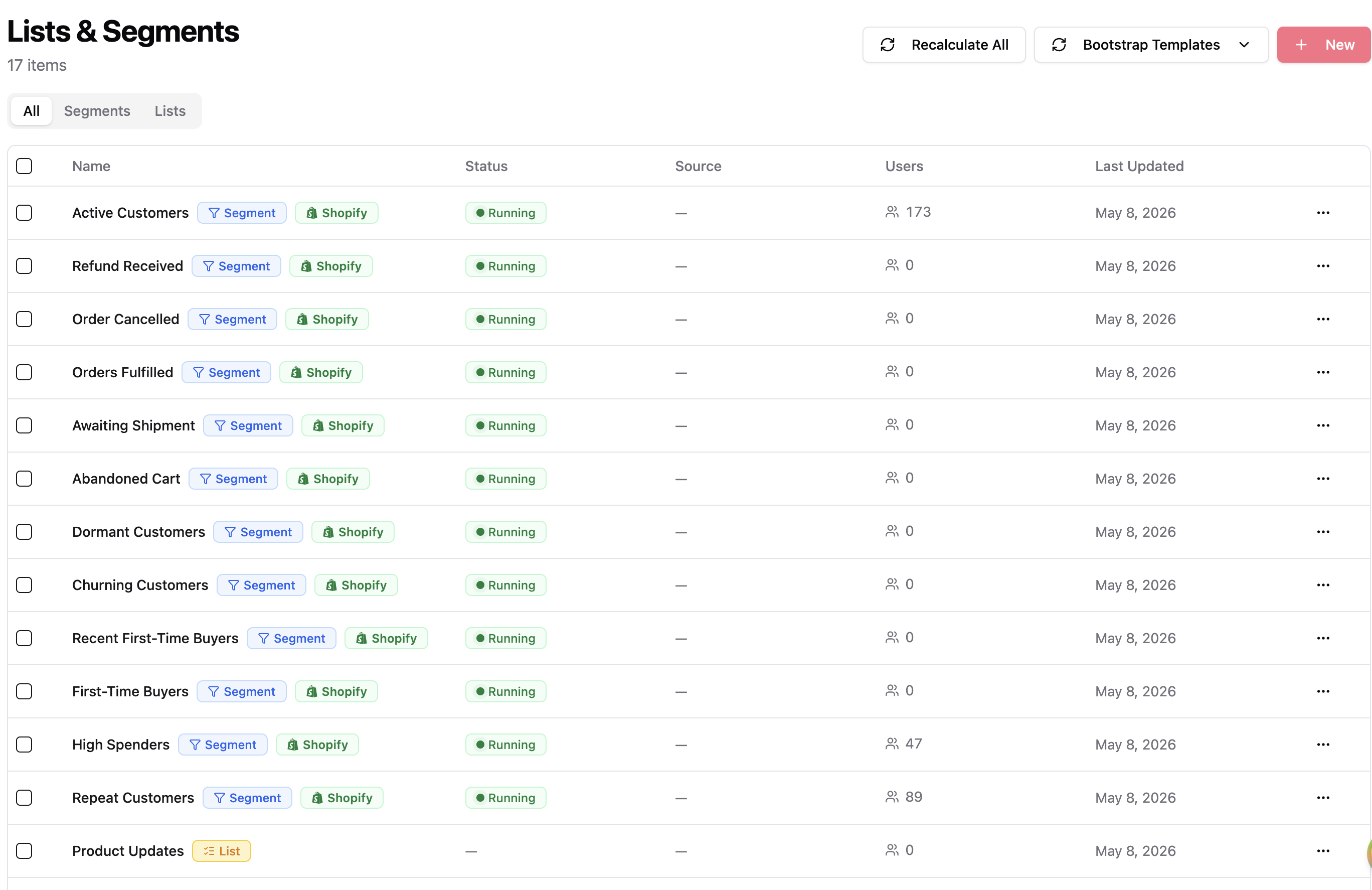
Shopify and Mailchimp: keep Shopify as the source of truth for products, orders, and customer consent. Verify the integration before building campaigns: audience mapping, consent, ecommerce events, product feeds, abandoned-cart triggers, unsubscribes, and revenue reporting. Start with a first-time-buyer or category-purchaser segment rather than a complex predictive workflow.
Shopify and Klaviyo: document segment, flow, suppression, and exit logic. Klaviyo can support complex personalization, but complexity becomes expensive when no one remembers why a split exists. Start with one lifecycle journey, define a holdout or baseline, and review profile growth and sending cost as part of the plan.
SegmentFlow: consolidate customer, order, product, engagement, and outcome signals, then describe the intended audience and campaign in plain language. Use customer segmentation to establish the audience and Growth Copilot to shorten the path from insight to campaign. Start with a measurable use case such as replenishment, category cross-sell, or win-back.
If your research spans onsite search, merchandising, popups, recommendations, and other channels—not email alone—use the broader guide to ecommerce personalization platforms and tools. For strategy and operating-model context, see how AI email marketing can increase customer lifetime value and email marketing for ecommerce without the complexity.
Measurement Checklist
Measure personalized email by commercial lift, not just engagement.
Track:
- revenue per campaign
- revenue per recipient
- click-to-order rate
- repeat purchase rate
- average order value
- product recommendation clicks
- unsubscribe and complaint rate
- bounce rate and delivery health
- revenue from automated flows vs one-off campaigns
The best signal is not "this email had a high open rate." The better signal is "this segment bought more often, bought more relevant products, or came back sooner than before."
FAQ
What is the best email personalization software?
The best email personalization software depends on your team. SegmentFlow is best for ecommerce teams that want AI-assisted segments, product-aware campaigns, and revenue attribution without heavy manual work. Klaviyo is best for advanced lifecycle marketers. Mailchimp is best when your audience and campaigns already live in Mailchimp.
How should ecommerce teams choose email personalization software?
Choose based on data access, workflow speed, personalization depth, integration fit, and revenue reporting. If the team is small, prioritize tools that reduce manual segment and campaign work. If the team has a dedicated lifecycle marketer, a more advanced manual platform can make sense.
What data is needed for email personalization software?
Start with customer profiles, marketing consent, order history, product catalog data, email engagement, and campaign revenue. Better personalization can also use browsing behavior, cart activity, discount usage, lifecycle stage, product affinity, and days since last purchase.
Is email personalization worth it for small ecommerce stores?
Yes, if it changes the audience, timing, products, or offer. A small store does not need an enterprise recommendation engine to personalize better. It can start with first-time buyers, repeat buyers, inactive customers, VIPs, abandoned carts, and product-category segments.
How long does email personalization take to implement?
A focused use case can launch quickly once identity, consent, orders, catalog data, and outcome tracking are reliable. A continuously optimized program takes longer because it also needs behavioral events, documented journey logic, quality assurance, measurement, and an owner.
Are product recommendations the same as email personalization?
No. Recommendations are one part of personalization. A useful program also changes the audience, timing, message, offer, and suppression logic based on customer behavior and lifecycle stage.
What is the difference between an ecommerce personalization platform and email personalization software?
Email personalization software focuses on audiences, messages, journeys, sending, and email outcomes. A broader ecommerce personalization platform may also control onsite search, merchandising, popups, recommendations, and other channels. Choose the narrower category when email execution is the problem; use the broader category when customer experience must change across the storefront and multiple channels.
How does SegmentFlow help with email personalization?
SegmentFlow helps ecommerce teams describe an audience and campaign in natural language, generate product-aware email creative, use Shopify or WooCommerce data, and measure revenue. It is built for teams that want more relevant emails without manually configuring every segment and template.
What should teams measure after improving email personalization?
Measure revenue per campaign, revenue per recipient, click-to-order rate, repeat purchase rate, average order value, product recommendation clicks, unsubscribe rate, complaint rate, bounces, and revenue from automated flows. Opens and clicks are diagnostics, not the final score.
Bottom Line
Email personalization software should make customer data easier to act on. If a platform creates more work than it removes, personalization will stay stuck in planning.
Use Klaviyo if you have the team to operate a sophisticated lifecycle program. Use Mailchimp if it is already your marketing hub and the Shopify sync is healthy. Use Omnisend when multichannel messaging matters. Use Nosto or Rebuy when the main constraint is product recommendations and merchandising.
Use SegmentFlow.ai when you want ecommerce email personalization to move faster: AI-built audiences, product-aware emails, and revenue reporting from your store data.
Related Posts
7 Best AI Email Marketing Platforms for Ecommerce in 2026
Compare the best AI email marketing platforms for ecommerce email: campaign planning, AI templates, segmentation, automation, deliverability, revenue attribution, and pricing.
Best Email Marketing Tools for Shopify: 2026 Guide
Compare the best email marketing tools for Shopify by setup, automation, personalization, integrations, and price, with a practical 2026 setup guide for today.
Best Ecommerce Personalization Tools: 2026 Guide
Compare 7 ecommerce personalization tools using a practical scorecard for customer data, setup, activation, Shopify fit, and measurable revenue impact.