Best Email Marketing Tools for Shopify: 2026 Guide
Compare the best email marketing tools for Shopify by setup, automation, personalization, integrations, and price, with a practical 2026 setup guide for today.
Email marketing for Shopify works best when your tool understands the store data behind every campaign: customers, orders, products, collections, discounts, consent, and revenue. The right platform should help you choose the audience, create the email, recommend products, send at the right moment, and prove what revenue came back.
Quick answer
For most Shopify stores, the best email marketing setup is a Shopify-connected platform that can use purchase history, customer behavior, product data, and campaign revenue in one workflow. SegmentFlow fits stores that want AI to build segmented campaigns quickly. Klaviyo fits advanced teams. Mailchimp fits stores already committed to Mailchimp. Shopify Messaging fits simple native sending.
The biggest mistake is choosing email marketing software for Shopify by feature count alone. Most stores do not lose revenue because they lack one more template. They lose revenue because campaigns take too long to build, segments are too broad, product recommendations are generic, and reporting stops at opens or clicks.
This guide compares the practical options and gives you a setup path for Shopify, Mailchimp, Klaviyo, and SegmentFlow workflows.
How we evaluated the best email marketing tools for Shopify
We compared each tool against the seven criteria that matter after the demo:
- Store stage: is it sensible for a new shop, a growing retention program, or an advanced lifecycle team?
- Setup effort: how quickly can you connect Shopify, authenticate sending, import products, and launch a useful campaign?
- Automation depth: can you run welcome, abandoned cart, post-purchase, win-back, replenishment, and VIP journeys?
- Personalization depth: can the tool use products bought, order value, last purchase date, engagement, and lifecycle stage?
- Shopify data access: which customer, order, catalog, consent, and behavioral fields are available and how quickly do they update?
- Reporting: can you connect a sent email to a click, order, sale, and repeat purchase in Shopify?
- Pricing model: does cost grow with contacts, active profiles, messages, or a combination of them?
For ecommerce teams, the real question is not "which platform has the most features?" It is "which platform helps us send relevant campaigns consistently without turning email into a full-time operations job?"
That is where the tool choice changes by store stage.
Quick Comparison
SegmentFlow: Best When Speed and Store Data Matter
SegmentFlow.ai is built for ecommerce teams that want better campaigns without living inside segment builders and template editors. You connect Shopify or WooCommerce, describe the campaign in plain English, and SegmentFlow helps create the audience, copy, design, products, send, and revenue attribution.
This makes it useful for Shopify stores where the bottleneck is not lack of data. The bottleneck is turning that data into campaigns.
For example, instead of manually building filters, you can describe a segment like:
- "Customers who bought once but have not ordered again in 60 days"
- "VIP customers who spent more than $300 but did not buy this month"
- "People who bought running shoes but have never bought socks"
- "Subscribers who clicked a campaign recently but have not purchased"
SegmentFlow is strongest when you want:
- AI-created Shopify campaigns from customer and product data
- Customer segmentation in natural language
- Product-aware emails instead of generic AI copy
- Unlimited contacts with pricing based around email volume
- Reporting that connects email activity to Shopify revenue
It is not the right fit if you need a large legacy integration marketplace, enterprise procurement process, or a mature SMS/WhatsApp operating system today. For small Shopify teams that want email marketing to move faster, it is the most direct option.
Shopify Messaging: Best Native Starter Setup
Shopify Messaging is Shopify's own email and SMS campaign product. It lives inside Shopify, pulls from your products and branding, includes templates and automations, and gives reporting in the same place you manage the store. Shopify also documents how its marketing automations use workflows, triggers, conditions, and actions.
Shopify says stores can send up to 10,000 manual or automated emails per month for free, then pay usage-based pricing for additional email sends in a calendar month. Check the current Shopify Messaging email pricing before choosing it on price alone. It is a good first step for new stores that want basic newsletters, product announcements, win-back emails, and simple automations without another platform.
Choose Shopify Messaging when:
- your store is new or still simple
- you want the least setup friction
- you mostly send newsletters and basic promotions
- you do not want a separate contact database yet
- native Shopify reporting is enough
Move beyond it when you need deeper personalization, more advanced lifecycle logic, richer experimentation, or faster campaign generation from data.
Mailchimp for Shopify: Best If Mailchimp Is Already Your Hub
Mailchimp's Shopify integration connects Shopify data to Mailchimp so ecommerce teams can run email, forms, automations, product recommendations, and revenue tracking from Mailchimp.
Mailchimp makes sense if you already use it as your marketing hub or if your business sells through channels beyond Shopify and needs a broader audience database. The app can sync Shopify segments, use ecommerce events, and support common flows such as welcome, abandoned cart, browse abandonment, price drop, and win-back campaigns.
The tradeoff is operational complexity. Shopify and Mailchimp now both hold important customer data, so you need to watch audience sync, consent, unsubscribe handling, duplicate contacts, tags, product feeds, attribution, and contact-based pricing.
Use Mailchimp when:
- you already have forms, lists, and automations in Mailchimp
- you need one marketing CRM beyond Shopify
- you want more template and campaign tooling than the native Shopify option
- your team is comfortable maintaining audience hygiene
If your main pain is syncing customers cleanly, use the guide on how to sync Shopify customers with Mailchimp. If you are deciding between the native tool and Mailchimp, compare Shopify Email vs Mailchimp.
Klaviyo for Shopify: Best for Advanced Lifecycle Teams
Klaviyo is one of the strongest traditional ecommerce ESPs for Shopify. It gives teams deep segmentation, flow logic, ecommerce event tracking, SMS, analytics, customer profiles, and a large ecosystem of agencies and integrations.
Klaviyo is a good fit when you have a lifecycle marketer, agency, or internal operator who can build and maintain a serious email program. It gives a lot of control, which is valuable when you know what to do with it.
That control can be a burden for smaller teams. Klaviyo's free tier is useful for testing, but limits and prices can change. Use Klaviyo's current pricing calculator with your real active-profile count and sending volume rather than judging it by the entry point.
Use Klaviyo when:
- email and SMS are already major revenue channels
- you need granular flows and segmentation
- you have someone responsible for lifecycle marketing
- you want a mature partner and integration ecosystem
- you can maintain templates, tests, suppressions, and reporting
If your store has the data but not the time, SegmentFlow may be a better first operating layer. If your store has a dedicated lifecycle team, Klaviyo gives that team more manual depth.
Omnisend, Drip, and Privy: Where They Fit
Omnisend is useful when you want email, SMS, and web push in one ecommerce-focused platform. It includes automations, segmentation, dynamic content, and product recommendation blocks. It is often a practical middle ground for stores that want more than Shopify's native tool but do not want a heavier Klaviyo setup.
Drip is useful for content-led ecommerce brands that need email, onsite campaigns, dynamic segments, prebuilt playbooks, and customer education workflows. It works best when email is part of a broader relationship-building program, not just promotional blasts.
Privy is strongest for list growth, popups, forms, cart savers, and simpler email/SMS campaigns. It is a good fit when the first problem is subscriber capture. It is less ideal when the main problem is advanced personalization or full lifecycle email strategy.
How to Choose the Right Setup
Use the constraint that actually blocks growth:
- You need the simplest Shopify-native start: use Shopify Messaging.
- You already run Mailchimp and need Shopify data there: use Mailchimp.
- You have a dedicated lifecycle marketer: use Klaviyo.
- You need email, SMS, and push together: compare Omnisend.
- You need popups and subscriber capture first: use Privy.
- You want AI to turn Shopify data into campaigns faster: use SegmentFlow.
The decision should come from workflow, not preference. If your team ships two campaigns a month because every send takes hours, a complex platform may not help. If your team ships ten campaigns a week and needs granular testing, a more manual tool can be worth it.
A practical Shopify email marketing setup
Start with this setup before adding complexity.
1. Connect store and customer data
Connect Shopify, then confirm that customers, products, orders, discounts, and marketing consent update correctly. Authenticate your sending domain before scaling volume; Shopify documents where to configure the sender email and domain authentication.
2. Build useful customer segments
Begin with new subscribers, first-time buyers, repeat buyers, VIPs, inactive buyers, recent browsers, cart abandoners, and unengaged contacts. These segments should update automatically as customers buy or engage.
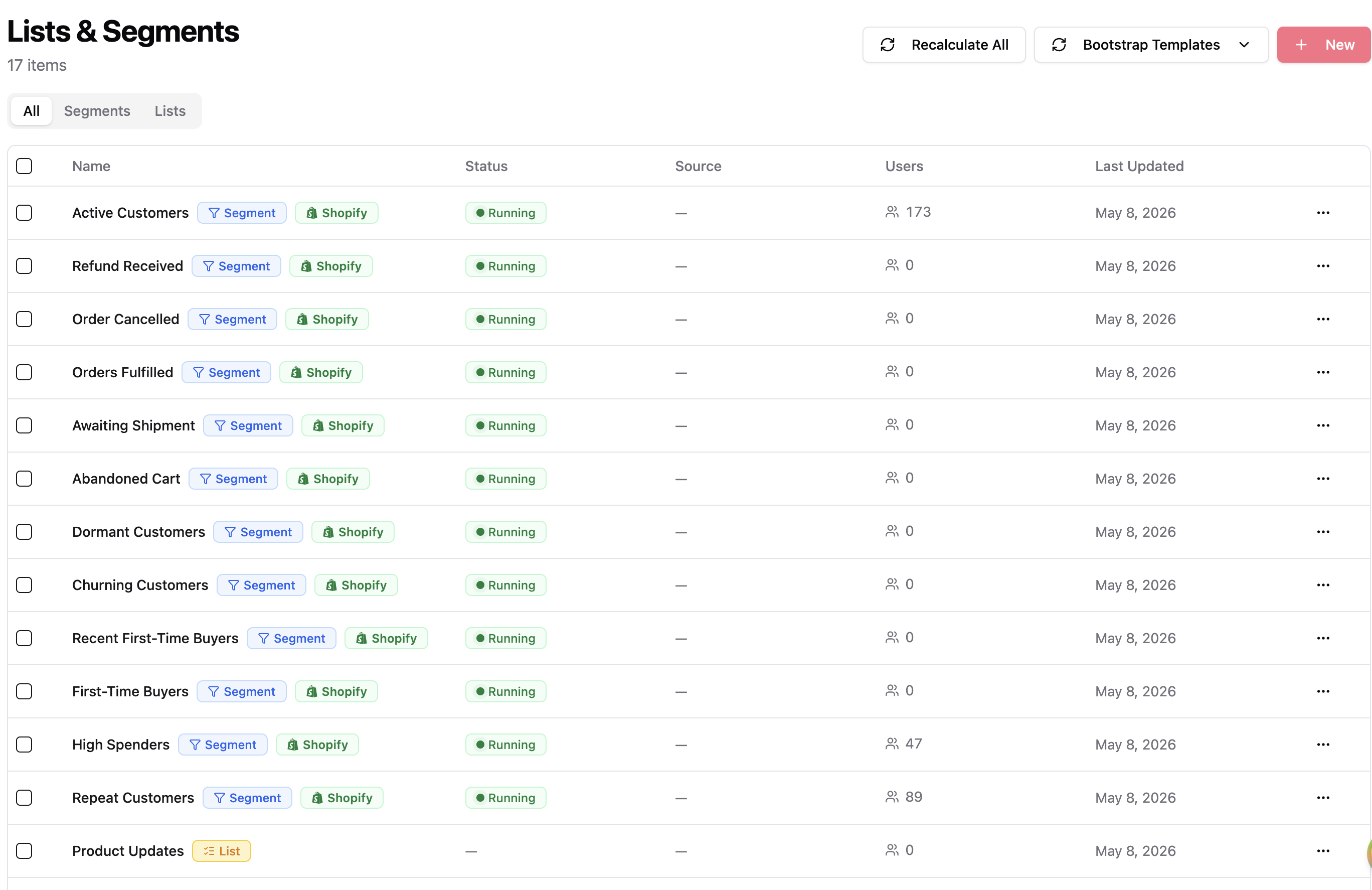
A first-time buyer might receive product education and a complementary recommendation. A repeat buyer might receive early access or a replenishment reminder. A customer showing signs of churn might receive a win-back message based on their last category or product.
3. Launch essential journeys
Launch welcome, abandoned-cart, post-purchase, and win-back automations first. Give every journey one owner, a clear entry condition, an exit condition, and a measurable business goal.
4. Add product recommendations
Use catalog and order data to recommend products that complement an actual purchase or fit the customer's category history. Avoid showing the same generic bestseller block to everyone.
5. Measure revenue and improve
Review revenue per recipient, click-to-order rate, repeat purchases, unsubscribes, bounces, and complaints. Use the winning audience and offer as the starting point for the next campaign.
If you want a simpler AI-assisted version, SegmentFlow can turn a plain-English campaign idea into the audience, email, product blocks, and reporting workflow. That is the point of the Growth Copilot: fewer manual steps between "we should send this" and a campaign that is live.
For lower-cost starting points, compare the best free email marketing apps for Shopify before adding another paid platform.
Measurement Checklist
Track email marketing for Shopify by business outcome first:
- Revenue per campaign: how much Shopify revenue was attributed to the email?
- Revenue per recipient: did the segment justify the send?
- Click-to-order rate: did clicks become purchases?
- Repeat purchase rate: did campaigns bring existing buyers back?
- Average order value: did recommendations increase basket size?
- Unsubscribe and complaint rate: did targeting protect list quality?
- Bounce rate and delivery health: did the campaign reach inboxes?
Open rate can still help diagnose subject lines and sender trust, but it should not be the main success metric. The goal is not a busy email dashboard. The goal is profitable repeat purchases from customers you already have.
FAQ
What is the best email marketing for Shopify?
The best email marketing for Shopify depends on your operating model. SegmentFlow is best for small ecommerce teams that want AI-generated campaigns from Shopify data. Shopify Messaging is best for simple native sending. Mailchimp is best if you already use Mailchimp as your marketing hub. Klaviyo is best for advanced lifecycle teams that want deep manual control.
How should ecommerce teams choose email marketing for Shopify?
Choose by workflow constraint: setup speed, personalization depth, automation needs, reporting quality, and the amount of manual work your team can handle. A store with no lifecycle marketer usually needs simplicity and AI-assisted execution. A store with a dedicated retention team may benefit from a more advanced manual platform.
What data is needed for Shopify email marketing?
You need customer profiles, marketing consent, order history, product catalog data, collections, discounts, engagement history, and campaign revenue. Better personalization comes from combining those signals into segments such as first-time buyers, VIPs, inactive customers, recent browsers, and customers likely to reorder.
Is Mailchimp good for Shopify email marketing?
Mailchimp can be good for Shopify if you already use it for lists, forms, campaigns, and automations. The key is maintaining a healthy Shopify sync, clean audience data, correct consent, and accurate revenue tracking. If you only need simple native campaigns, Shopify Messaging is easier. If you want AI to generate campaigns from store data, SegmentFlow is more direct.
Is Klaviyo better than Mailchimp for Shopify?
Klaviyo is usually better for advanced Shopify lifecycle marketing because it is deeply ecommerce-focused and gives more control over segments, flows, profiles, and analytics. Mailchimp can be better if your business already depends on Mailchimp's broader marketing CRM or sells through multiple channels. The better tool is the one your team will actually maintain.
Is Shopify Messaging enough for a small store?
It can be. Shopify Messaging is a practical native choice for newsletters and basic automations when you want minimal setup. Add a more specialized platform when you can name the missing capability—such as deeper segmentation, cross-channel journeys, or faster campaign production—and have the data and team to use it.
Can I start Shopify email marketing for free?
Yes. Several tools offer limited free use, but the limits and pricing models differ. Compare active-profile, contact, and send limits using each vendor's current pricing page, then estimate the cost at your expected list size and monthly volume.
Which Shopify email automations should I launch first?
Start with welcome, abandoned cart, post-purchase, and win-back. These cover acquisition, conversion, customer experience, and retention without creating an unmanageable program.
How does SegmentFlow help with email marketing for Shopify?
SegmentFlow helps Shopify teams turn customer behavior, purchase history, product data, and campaign results into email campaigns. You can describe the audience and campaign in natural language, generate product-aware creative, send to a sharper segment, and measure revenue without building every rule and template manually.
What should teams measure after improving Shopify email marketing?
Measure revenue per campaign, revenue per recipient, click-to-order rate, repeat purchase rate, unsubscribes, spam complaints, bounces, and delivery health. Opens and clicks are useful, but Shopify email marketing should ultimately be judged by profitable orders and better customer retention.
Bottom Line
Email marketing for Shopify is not only a tool decision. It is an operating decision.
Use Shopify Messaging if you need the simplest built-in start. Use Mailchimp if it is already your marketing hub. Use Klaviyo if you have the team to operate a sophisticated lifecycle program. Use Omnisend, Drip, or Privy when their channel mix or list-growth tools match your stage.
Use SegmentFlow.ai when you want Shopify email campaigns created from customer data faster: clearer segments, product-aware emails, and revenue reporting without the manual drag.
Related Posts
7 Best AI Email Marketing Platforms for Ecommerce in 2026
Compare the best AI email marketing platforms for ecommerce email: campaign planning, AI templates, segmentation, automation, deliverability, revenue attribution, and pricing.
Best Free Email Marketing Apps for Shopify
Compare free Shopify email marketing apps for newsletters, popups, automations, SMS, segmentation, and ecommerce email growth.
Shopify Email Marketing Pricing: 2026 Guide
Understand Shopify email marketing pricing across Shopify Messaging, Mailchimp, Klaviyo, Omnisend, and SegmentFlow before choosing a tool.